
FedSubK Feature: The Acquisition Lifecycle of Service Contracts - Phase 2 Contract Formation and Source Selection
Updated: May 4, 2024
This month we continue with an overview of the second phase of the acquisition lifecycle for Federal service contracts; Contract Formation and Source Selection (or “Award” Phase). (NOTE: If you missed last month, you can find Part 1 here.)
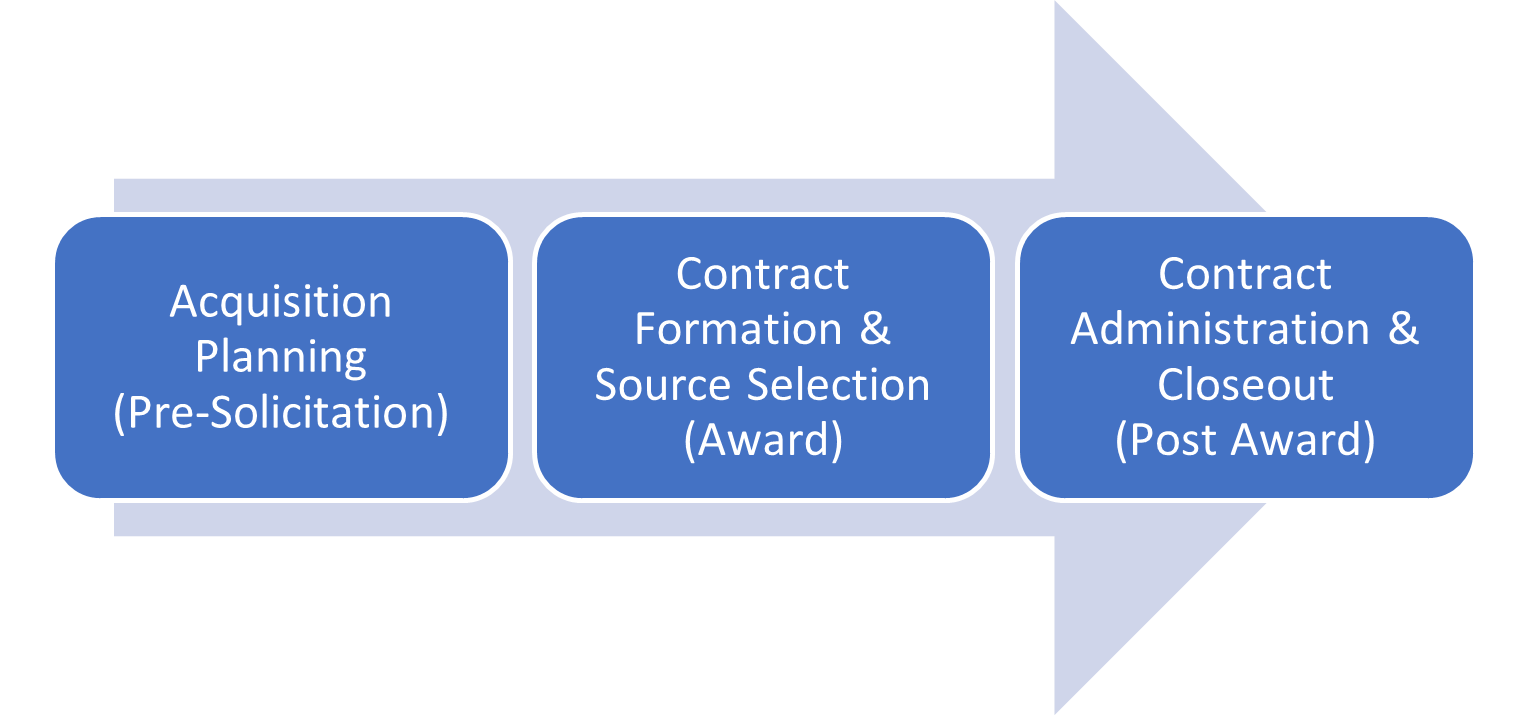
We will talk about each subactivity in this phase but first, let’s remind everyone of the lifecycle of a typical Federal services contract valued over the Simplified Acquisition Threshold (or “SAT,” presently $250,000).
Figure 1 – Acquisition Lifecycle
Contract Formation & Source Selection (Award)
The Contract Formation and Source Selection (Award) phase begins at the point when Acquisition Planning is completed, and the method of procurement has been established. Tasks in this phase are shown below.
Figure 2 – Steps in the Contract Formation & Source Selection (Award) Phase
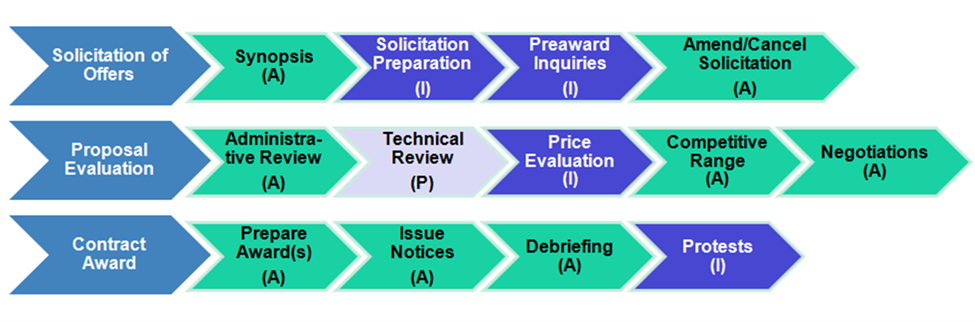
Legend: I = Integrated Project Team, P = Project Management Office / Requestor, and A = Acquisition Office
These tasks will culminate in an awarded contract (or contracts) and a path that is free of obstacles for the awardee to start contract performance.
Let’s go over a few key tasks in this phase and their impacts on you, the potential offeror.
Pre-Solicitation Notice (“Notice of Proposed Contract Action” or “Advance Notice”) (FAR Subpart 5.203)
Agencies must publish a Pre-Solicitation Notice in the Contract Opportunities section of SAM.gov at least 15 calendar days before the solicitation is issued, or before issuing a solicitation or proposed contract action the Government intends to solicit and negotiate with only one source (see FAR Subpart 6.302-1).
This notice period may be shorter than 15 calendar days, at the discretion of the Contracting Officer (CO/KO) when acquiring commercial products or commercial services. The period can also be shorter when the CO/KO uses the combined synopsis and solicitation procedure outlined in FAR Subpart 12.603. (Note: See the FedSubK Feature “Navigating Federal Contract Opportunity Notices” for more info.)
The Pre-Solicitation Notice is important because it–
- Gives a summary of the upcoming project,
- Discloses the acquisition strategy to be used in terms of competition and contract type,
- Provides the estimated date for issuance of the solicitation to the public and the response time, and
- Outlines other special instructions such as pre-proposal conferences planned.
From this notice alone, many businesses can make their go/no-go decisions on whether to propose.
For the Government, this 15-day period is crunch time. It’s when final approvals are obtained to release the documents to the public. If something comes up (and it always seems to), the 15 days may be extended for any length of time by the Government without further notice to the public. However, it is always in the Government’s best interest to ensure its competition pool knows when the solicitation will be published. The solicitation issuance date in the notice is an estimated release date.
For sole source actions offered to the Small Business Administration (SBA) 8(a) Business Development Program, a pre-solicitation notice is NOT required.
Solicitation Issuance
Once at least 15 days have passed, the solicitation will be uploaded in the GPE under a separate notice. This notice will contain a synopsis of the project along with solicitation documents and all attachments made available for download by potential offerors. Now the real fun begins because the clock is ticking!
(See FedSubK Snapshot “Finding Your Way Around a Federal Solicitation” for more info about where to find solicitation response times and instructions to ask questions, seek clarification, and how to format and submit proposals.)
You’ve got a lot of moving parts once the RFP goes “live.” Here are some key things, from a CO/KO perspective, that offerors need to keep in mind as they develop their proposal.
#1 - Know the Rules for Government Exchanges with Industry Before Receipt of Proposals (FAR Subpart 15.201)
Exchanges of information between the Government and Industry are encouraged. However, any exchange must be consistent with the procurement integrity requirements of FAR Subpart 3.104. This includes not only exchanges but also disclosure, protection, and marking of contractor proposal information and source selection information.
Exchanges after issuance of the solicitation but before receipt of proposals are used by the Government to improve potential offerors’ understanding of requirements and allow them the chance to determine their ability to meet those requirements. These exchanges often take the form of questions from industry on RFP documents, answers in response from the Government, and pre-proposal conferences. The CO/KO oversees and controls these exchanges.
Draft RFPs for industry input are considered part of the market research process under acquisition planning.
#2 - Watch for Amendments! (FAR Subpart 15.206)
Changes to the RFP documents are made by formal amendment to the solicitation before the established time and date for receipt of proposals. Amendments must provide sufficient time for potential offerors to digest changes and update proposals. Each amendment will also be announced with its own notice and published in the GPE. Amendment notices will provide a synopsis of changes made.
Amendments can also be issued after the close of receipt of offers/proposals. However, per subparagraph (e) of the referenced FAR Subpart, if the CO/KO determines that such an amendment “...is so substantial as to exceed what prospective offerors reasonably could have anticipated so that additional sources likely would have submitted offers had the substance of the amendment been known to them”, the CO/KO must cancel the original solicitation and issue a new one, regardless of the stage of the acquisition.
An oral notice may also be used when time is of the essence, which is then formalized by a written amendment issued by the CO/KO.
The worst possible thing is to finish a proposal and realize you haven’t taken an amendment into account. Failure to acknowledge an amendment can be grounds to eliminate your proposal from consideration right out of the gate!
#3 - Understand the Basics of Different Source Selection Techniques (FAR Subpart 15.1)
Techniques for the selection of sources under competitive procurements fall within a range called the Best Value Continuum. This range equates to the Government’s perceived risk of unsuccessful performance which is then translated into the prioritization of technical factors and cost or price factors and their individual and collective importance.
An agency may use only one or a combination of the Tradeoff Process and the Lowest Price Technically Acceptable Process to arrive at the determination of the best value for the Government. The characteristics of each are found in the table below.
Tradeoff Process
- Allows selection of other than the lowest-priced or highest technically rated offeror using tradeoffs between technical superiority and cost or price, as described in the solicitation.
- The technical factors and significant subfactors that affect contract award and their relative importance are disclosed in the RFP.
- The RFP also includes a statement whether all evaluation factor factors other than cost or price (aka “technical factors” when combined, are–
- Significantly more important than cost or price,
- Approximately equal to cost or price, or
- Significantly less important than cost or price.
- Past performance is a required evaluation factor.
- Factors and significant subfactors establish a list of criteria describing required or desired skills and experience against which the proposal is subjectively evaluated.
- Technical ratings are subjective and use a rating scale of adjectival descriptors, colors, numerical weights, or original rankings. Cost or Price is evaluated, not rated.
- Provides the greatest flexibility for the Government to achieve the best balance of technical and cost/price acceptability.
- Any perceived benefits of a higher-priced proposal require supporting documentation to quantify the payment of any additional cost in terms of specific benefits to the Government.
- The point-by-point tradeoff decision is documented and reviewed as required by FAR, any agency FAR supplement, and agency policy.
Lowest Price Technically Acceptable Process
- Requires selection of the technically acceptable proposal with the lowest evaluated price
- Technical factors are not ranked by relative importance.
- Failure of a proposal to meet the minimum technical acceptability standard of any technical factor or subfactor automatically eliminates the proposal from further consideration.
- Past performance is not a required evaluation factor.
- Factors and significant subfactors establish objective thresholds of technical acceptability (measures) against which the proposal is evaluated.
- Technical ratings are objective and use a go/no-go, pass/fail, or acceptable/unacceptable scale. Cost or Price is evaluated, not rated.
- Provides the ability to achieve a minimum technical acceptability level on all technical factors and significant subfactors and achieve the lowest evaluated price.
- Only the lowest-priced proposal of the proposals found to be technically acceptable is considered for award.
- Tradeoffs are not allowed.
#4 - Award Without Discussions or Competitive Range? (FAR Subpart 15.306(c))
The Government has a choice. It can choose to make a contract award decision based solely on initial proposals and not engage with offerors, or it can establish a competitive range to conduct discussions (aka, negotiations) before an award is made.
What’s a competitive range? Based on the ratings of each proposal against all evaluation criteria, the CO/KO will establish a competitive range comprised of all of the most highly rated proposals; those most likely to receive the contract award. It’s a down-selection. The competitive range can be further reduced for purposes of efficiency when documented with the rationale why and the solicitation so states.
The solicitation will disclose the Government’s choice. This choice is important. An award without discussions means you get one shot – the first shot – to get your proposal right. There are no fixes or changes allowed later. However, even when the Government chooses “award without discussions,” it always reserves the right to open discussions with offerors if it is in the Government’s best interest to do so. But don’t rely on it happening. If the Government can avoid discussions before the award, it will; trust me on that. It saves weeks of work and documentation when discussions are avoided.
Now that we understand the processes that can be used in source selection, let’s talk about how it gets accomplished.
Source Selection Evaluation Board (SSEB). Before the solicitation ever hit the street, the Source Selection Evaluation Board (SSEB) members were chosen. Who are those people? Let’s talk about that and what they do in the evaluation in general.
Technical Evaluation Board (TEB). Comprised of technical and subject matter experts familiar with the work to be performed who are trained in the technical evaluation processes to be used, and supported by the CO/KO and the Small Business Specialist, who assist when subcontract performance is included as an evaluation factor. The TEB chair is most often the project lead who will oversee the daily work during contract performance AND will likely be assigned as the Contracting Officer’s Representative (COR). (See FedSubK Feature: “Hate the Game, Not the Players: Know the Roles in Federal Contracting” for more about the roles in Federal contracting.)
(HINT: If the Government held a pre-proposal conference, members of the TEB were likely involved in the Government presentations. You likely introduced yourself or engaged in chit-chat. But don’t think you can ask, and Government personnel will tell you they are on the TEB; they are required to sign a Non-Disclosure Agreement to participate. If someone tells you they are a TEB member, report it to the CO/KO immediately.)
The technical evaluation is completed fully independent of the price evaluation. The TEB membership is provided only with a copy of those portions of the proposals that address the technical factors only; the TEB is not privy to the costs or prices proposed at any time during the evaluation. Each member of the TEB first completes an independent individual evaluation of each proposal. Then the TEB meets to agree on a single consensus evaluation as a group; there is no voting.
- Tradeoff Process – TEB members document in detail the strengths, weaknesses, significant weaknesses, and deficiencies of each proposal against the evaluation criteria disclosed in the solicitation and apply a rating.
- LPTA Process – After comparing the technical proposal to the measure for each factor and significant subfactor an objective rating is given (i.e., pass/fail).
The output of the TEB is an evaluation report of initial proposals supported by individual and consensus rating sheets for each technical proposal along with a list of any questions the TEB may have for offerors about their technical proposal.
Price Evaluation. Price evaluation is typically performed by the CO/KO with support from other subject matter experts such as a cost estimator, data analyst, auditor (and audit report), or cost/price analyst. Price is not rated but evaluated according to the solicitation. That evaluation is most often based on competition which is used to establish price reasonableness. However, in some situations, cost analysis may be required when prices appear skewed dramatically between offerors or when a cost-reimbursement contract is being used. In the case of large solicitations or those with multiple awards, a Price Evaluation Board (PEB) may be seated to streamline the price evaluation process. A full discussion of the price and cost analysis techniques that the Government may use are found in FAR Subpart 15.404 and 15.407, in case you need a sleep aid some night.
While all this evaluation is going on, it’s a waiting game. But there are a couple more things about the process to know.
#1 - What Exchanges Can Occur with the Government after Submission of Proposals (FAR Subpart 15.306)
[My advice…don’t pick up the phone and start bugging the CO/KO about what they thought of your proposal, ask when the selection will be done or a status update, or remind them of the proposal period that is ticking away. One, they will definitely remember you, and not in a good way. Two, they can’t tell you anything.] There are, however, three (3) types of exchanges that can occur with the Government after you submit your proposal. They are:
- Clarifications – clarify only certain aspects or resolve minor or clerical errors.
- Communications before the establishment of the competitive range (discussed below) – used to address adverse past performance information to which the offeror has not had the opportunity to respond.
- Exchanges after establishment of the competitive range – these are negotiations (aka, Discussions) tailored to each proposal.
#2 - Negotiations (Discussions)
After the initial proposal evaluations are complete, negotiations are exchanges that are undertaken with the intent of allowing the offeror to revise its proposal. At a minimum, the CO/KO must discuss with each offeror still being considered for award any deficiencies, significant weaknesses, and adverse past performance information to which the offeror has not yet had an opportunity to respond. The CO/KO is encouraged to discuss other aspects of the offeror’s proposal that could, in the opinion of the CO/KO, be altered or explained such that it materially enhances the proposal’s potential for award. However, the CO/KO is not required to discuss every area where the proposal could be improved. The scope and extent of discussions are a matter of the CO/KO’s judgment.
In discussing other aspects of the proposal, the Government may, in situations where the solicitation stated that evaluation credit would be given for technical solutions exceeding any mandatory minimums, negotiate with offerors for increased performance beyond any mandatory minimums, and the Government may suggest to offerors that have exceeded any mandatory minimums (in ways that are not integral to the design), that their proposals would be more competitive if the excesses were removed and the offered price decreased.
During all exchanges with industry, Government personnel need to exercise caution so as not to engage in any conduct or communications that-
- Favors one offeror over another,
- Reveals an offeror's technical solution,
- Reveals an offeror’s price without that offeror’s permission,
- Reveals the names of individuals supplying reference information about an offeror’s past performance, or
- Knowingly furnish protected source selection information (i.e., IGCE, acquisition strategy discussions, identities of evaluators, etc.).
#3 - Proposal Revisions (FAR Subpart 15.307)
Should the Government decide to establish a competitive range, proposal revisions may be requested in response to the Government’s initial evaluation findings. Every offeror still included in the competitive range will have the opportunity to provide a proposal revision. After negotiations, the Government will allow offerors to submit a Final Proposal Revision (FPR). Typically, the Government will set a firm date/time for the FPR submission.
We are at the point in the process where we need a drum roll, please. A DECISION!
Source Selection Decision (FAR Subpart 15.308).
Negotiations are done, FPRs are submitted, and the dust starts to settle as the Source Selection Authority (SSA) makes the source selection decision. The CO/KO is designated as the SSA unless the agency head appoints another individual for a program or category of contracts.
The decision is typically based on a comparative assessment of proposals as completed by the TEB and PEB. While the SSA most often uses Board reports and analyses to make the decision, the decision must represent the SSA’s independent judgment. If, by chance, the SSA disagrees with any of the assessments done by others, it typically sends the reports back to the Board(s), pointing out errors or discrepancies for re-review and correction.
However, the SSA may also decide to do an independent assessment of the facts and proposals without sending the information back to the Boards. The SSA would then document the discrepancies found, its assessment, the supporting information and facts used, and its reliance on its assessment in the final source selection decision. (This latter scenario rarely happens. However, when it does, it opens a HUGE protest door. I’ve seen a protest won on a very large Governmentwide contract because the SSA did not properly document the reason for its disregard for the TEB’s evaluation nor provided the supporting documentation relied upon for the decision made.)
The source selection decision is documented and includes the rationale for any business judgments and tradeoffs made or relied on by the SSA, including benefits associated with additional costs.
You’d think once a source is selected, it would be easy after that, right? Well, the source selection only identifies the “otherwise successful offeror(s).” There is still a lot for the CO/KO to do before the selected source(s) can be awarded a contract.
Responsibility Determination (FAR Subpart 9.1)
Once a source is selected, the CO/KO must make an affirmative written determination of responsibility. The general standards of responsibility are:
- Having adequate financial resources to perform the contract, or the ability to obtain them (FAR Subpart 9.104-3(a));
- Being able to comply with the required or proposed delivery or performance schedule, taking into consideration all existing commercial and governmental business commitments;
- Having a satisfactory performance record (FAR Subpart 9.104-3 (b) and FAR Subpart 42.15).
- Having a satisfactory record of integrity and business ethics (FAR Subpart 42.15);
- Having the necessary organization, experience, accounting and operational controls, and technical skills, or the ability to obtain them (including, as appropriate, such elements as production control procedures, property control systems, quality assurance measures, and safety programs applicable to materials to be produced or services to be performed by the prospective contractor and subcontractors). (FAR 9.104-3(a).)
- Having the necessary production, construction, and technical equipment and facilities, or the ability to obtain them, as applicable (FAR 9.104-3(a)); and
- Being otherwise qualified and eligible to receive an award under applicable laws and regulations.
For small businesses, this responsibility determination includes the ability to meet the limitations on subcontracting found in FAR clause 52.219-14.
Congressional Notification (FAR Subpart 17.108)
CO/KOs must make information available on contract awards valued over $4.5 million (or at a threshold established by the agency) in time or the agency to announce it by 5 p.m. Eastern on the day of the award and agencies cannot make separate announcements before that time. Notifications excluded are:
(1) Those placed with the SBA under Section 8(a) of the Small Business Act;
(2) Those placed with foreign firms when the place of delivery or performance is outside the United States and its outlying areas; and
(3) Those for which a synopsis of the solicitation was exempted.
AND PAPERWORK (for the CO). But…before the ink has dried on that freshly signed contract…one thing must happen...
Notification of Unsuccessful Offerors and Debriefings (FAR Subpart 15.505 and 15.506)
Offerors eliminated from the Government’s competitive range may request a pre-award debriefing. The Government may refuse a pre-award debriefing request for compelling reasons if it is in the best interest of the Government. Offerors also should note that the information shared by the Government in a pre-award debriefing may be limited compared to the information the offeror will receive in a post-award debriefing.
The Government must conduct post-award debriefings with both successful and unsuccessful offerors upon receipt of a timely request (i.e., a request received within 3 days after the date on which the offeror received notification of a contract award). However, offerors are entitled to no more than one debriefing for each proposal, meaning if your firm received a pre-award debriefing the Government is not required to provide the business with a post-award debriefing. Offerors should consider the information available in each type of debriefing and decide when best to submit their debriefing request, pre- or post-award.
Offerors who submit an untimely debriefing request lose their right to a pre- or post-award debriefing.
AND another we pray doesn't.
Protest (FAR Subpart 15.507 and Subpart 33.1)
A Protest is a written objection by an interested party to any of the following a solicitation, cancellation of a solicitation, award or proposed award of a contract, or termination or cancellation of an award. Protests can be filed before the award or after the award. Protests can be filed to the agency or the Government Accountability Office (GAO) depending on circumstances.
Protests based on alleged apparent improprieties in a solicitation must be filed before bid opening or the closing date for receipt of proposals. Protests are often filed after the award and must be made within 10 days after the contract award or within 5 days after a debriefing date offered to the protester for any debriefing that is required, whichever is later. Performance is immediately suspended pending resolution of the protest unless continuing performance is in the best interest of the Government or urgent and compelling circumstances exist that will not allow waiting for a decision.
When filed with the agency, it is in the parties’ best interest to resolve all concerns raised by an interested party using “open and frank discussions” and the protestor may request an independent review of their protest at one level above the contracting officer by an employee with no previous personal involvement in the procurement. Agencies must make all efforts to resolve agency protests within 35 days after the protest is filed. When filed with the GAO, a recommendation on the protest is due within 100 days from the date of filing or within 65 days under the express option.
Phew! We made it!
Whether it was done in a month or over several (because it CAN take some time depending on the number of proposals received), it’s a meticulous process that is closely guarded by the CO/KO to move forward expeditiously to where meeting the mission starts and the customer gets what they need. Understanding this process helps you anticipate pitfalls as you prepare your proposal, navigate them when they occur, have a realistic expectation for the timeline, and celebrate your victory or move on with critical information for the next proposal.
Join us next month as we wrap up this series with the Contract Administration (Post-Award) Phase.
.webp)
View related posts
The FAR is Changing. So Is the Way We Learn (Weathering the RFO - Part 7)
When I first became a contracting officer, there wasn't one place you learned federal acquisition.
You learned a little from the FAR. You learned from your supervisor. You learned from legal counsel after asking what felt like a hundred questions. You learned from experienced contracting officers who had already made the mistakes you were trying to avoid. You learned from GAO decisions, Inspector General reports, policy memoranda, training courses, and occasionally from acquisitions that didn't go quite the way anyone planned.
Over time, those experiences came together to form something that's difficult to define but easy to recognize. Professional judgment.
That's what separates someone who knows the FAR from someone who knows how to apply it.
As I work through reading the proposed rules on the Revolutionary FAR Overhaul (RFO), I keep coming back to one thought – which is something I learned as a Team Lead, a Branch Chief, a Chief, and an Acquisition Workforce Training Coordinator –
It’s not about writing a shorter FAR.
Throughout this series I’ve said it’s easy to focus on what has been removed from the FAR. Yes, we see a leaner document. But that’s not the biggest change.
The RFO separated regulatory requirements from implementation knowledge.
Today, acquisition professionals are working within a broader knowledge ecosystem than many of us grew up with.
1) While the FAR establishes the regulatory framework, the FAR Companion now provides the context for implementation of that framework.
2) Practitioner Albums now explain all of the thinking behind the changes and illustrate how the revised framework is intended to work in practice.
3) Agency deviations implement the revised structure while revisions continue and the RFO moves through the formal rulemaking process.
4) Agency supplements, policy memoranda, training resources, and professional education fill in the gaps.
It's a different model for how acquisition professionals access information.
Let Me Tell You A Story…
When I arrived at GSA in 2012, part of my job was training and developing a contracting staff of more than 50 people at different stages of experience and certification. In fact, part of the application process was developing an Acquisition Workforce Training and Development Plan. Apparently, that requirement scared everyone else away. I was the only person who applied.
My first few weeks taught me something else: GSA's acquisition policy and workforce information was scattered EVERYWHERE. Shared drives. Policy sites. Old documents. Poorly labeled documents. Finding what you needed was a nightmare.
About that time, GSA Administrator Dan Tangherlini launched the Great Ideas Hunt. I submitted an idea for an Acquisition Portal where GSA could bring workforce, career development, policy, FAR, DOL, small business and other acquisition information together. The idea took off, and I served on the working group that developed the site's hierarchy. The value was pretty simple: people could find the information they needed in one place.
The RFO just took that model and said – naw.
Instead it says, “We believe in you, Acquisition Workforce! While there is less of you and you’ve lost some of your historical knowledge, we know you can read and you will find the information you need no matter where we put it. Happy hunting!”
The Bigger Change Isn’t the FAR
For most of my federal career, if someone asked me where to start researching a procurement issue, my answer was relatively straightforward. "Let's start with the FAR." It didn’t mean that the FAR had the full answer, but it gave everyone a common starting point with enough context and process to get you going quickly. But today, I don't think that's enough.
Today, based on conversations with Contracting Officers I know still on the job, it sounds more like this: "Let's start with the FAR. Then let's see what the Companion says. Let's look at the Practitioner Album. Was there an Executive Order on this? Has OFPP issued guidance? Is there an agency deviation that applies? Has GAO weighed in? Has anyone done this in our group yet?"
That's not necessarily a bad thing. Eventually it could be a better way of supporting an acquisition workforce that has to learn to adapt more quickly than traditional rulemaking allows. But it does change some important things.
It changes how they learn. And it adds time and risk.
From the Contracting Officer’s Chair
Putting information somewhere the workforce can access it is not the same thing as developing the workforce. A Practitioner Album can explain something. A course can teach it. Neither necessarily teaches a GS-11 contract specialist when to question the answer, when discretion is appropriate, when to elevate something, or what downstream consequence a seemingly small acquisition-planning decision may create.
Some of the best contracting officers I've known couldn't quote FAR citations from memory. But they knew the questions to ask. They could see risk in an underdeveloped requirement before it became a solicitation problem. They understood how an acquisition-planning decision could affect competition months later. And they knew when to bring in legal counsel, small business, or technical experts.
That's judgment. And judgment comes from experience, mentorship, continuous learning and professional discussion, not simply knowing where to find the rule.
I do have some optimism about this new knowledge model. It can make acquisition guidance far more responsive than regulation alone ever could. I've seen firsthand how long FAR rulemaking can take. It can take YEARS. Meanwhile, technology changes, commercial practices evolve, GAO issues decisions, agencies act, and new buying techniques emerge. The FAR Companion and Practitioner Albums give the acquisition community a way to capture some of that evolution much faster. That's a positive.
But it also creates a challenge: Knowledge is only valuable if people know where to find it, what authority it carries, and when to rely on it.
One of the strengths of the FAR has always been consistency. Whether you worked at the DHS, U.S. Army Corps of Engineers, GSA, or another agency, everyone started from the same regulation. Today, knowledge is intentionally distributed across multiple resources. That means consistency depends less on where information is published and more on how effectively the acquisition workforce understands the relationship among those resources. That's a leadership challenge. And it's a training challenge.
Contractors, consultants, attorneys, and proposal professionals are adapting to the same knowledge ecosystem. Understanding where acquisition thinking now lives is becoming just as important as understanding the regulation itself.
Frankly, understanding the regulation, processes, and people all connect is one reason I’m still active in this field – even if I’m sitting on the industry side now. I could go chase my dream of being a photog, sell my prints, or get back to the art I've set aside for too long. But one of the things I enjoyed most about supervising contracting professionals was watching the moment when someone stopped looking for answers and started asking better questions. That's when I knew they were growing into their craft.
The FAR can teach requirements, but experience teaches judgment. And good supervisors accelerate that process. And if the RFO expects contracting professionals to exercise more judgment and discretion, then supervisors need tools specifically designed to help them develop that judgment in others. Give a developing specialist an acquisition and make them explain not just what they would do, but where they found the authority, what discretion exists, what alternatives they considered, and why they made the recommendation. Build that thought process into acquisitions at the lowest levels.
As I think about the RFO, personally, I don't worry nearly as much about whether a paragraph moved from the FAR to the FAR Companion. What I think about is the next generation of contracting officers.
How do we help them develop judgment in this new environment?
How do we make sure they understand not just what the regulation says, but why it says it?
To me, that's one of the most important leadership questions raised by the RFO. And who will help them. Too often, leadership does what it it has always done – writes the change and tosses it over the fence. That won’t cut it this time if they expect real change and innovation.
Moving so much of that practical knowledge outside of the FAR is a significant shift. How will we know how well the workforce is taking it all in? We need a structured mechanism for practitioners to identify recurring interpretation problems, conflicting implementation, useful practices, or places where the FAR Companion and Practitioner Albums need clarification.
That turns the workforce from passive recipients into part of the learning system.
Handled well, shifting process out of the FAR could create a more agile workforce. But handled poorly, it could create uncertainty, inconsistent implementation, and uneven professional development. At this point, I don't think we've seen enough to know which outcome is more likely. Jaime Gracia has been raising similar concerns about acquisition workforce development, including his recent article, “The Procurement Workforce Problem No One Wants to Fund” at https://www.linkedin.com/pulse/copy-procurement-workforce-problem-one-wants-fund-jaime-gracia-vdmke/?trackingId=BVgMVDCyRY6vwzJDfBYkwQ%3D%3D. There still aren’t enough people having this conversation.
It deserves more attention than it's receiving. And the acquisition workforce deserves more training and leadership support than it is getting.
Three Things Leadership Needs to Think About Now
• Create a common learning framework.
• Develop supervisors as the bridge between guidance and judgment.
• Measure whether implementation is actually producing consistent professional practice.
The RFO may have made the FAR leaner. It did not make federal acquisition simpler to learn.
-------------------------------------------------
What’s next? Weathering the RFO will be back as we work through the latest RFO proposed rules covering several “meaty” FAR parts. Watch for more soon on LinkedIn and Substack.
Author: Shauna Weatherly, President, Federal Subcontract Solutions LLC (dba FedSubK). Shauna is a small business advocate and owner of FedSubK. FedSubK exists to simplify federal contracting, empowering small businesses with practical, understandable resources. We bring first-hand experiences in Federal contracting from multiple perspectives derived from roles held both in and out of Government over almost four decades of Federal service.
Visit us at fedsubk.com to learn more about--
Getting Started in Federal Contracting: fedsubk.com/begin-your-journey-here
Solutions and Our Trusted Support Provider Network: fedsubk.com/solutions-services
Insights from a Contracting Officer: fedsubk.com/insights
Free Webinars and Resources: fedsubk.com/webinars-training
When Judgement Carries More Weight (Weathering the RFO - Part 6)
You've probably heard some version of this complaint about federal acquisition: "If they would just let the Contracting Officer use some judgment..."
Okay. I get that. But then what?
I bring this up because the Revolutionary FAR Overhaul (RFO) is stripping away some of the detailed implementation language that generations of acquisition professionals grew up with.
The idea, at least in part, is to create more room for acquisition professionals to exercise discretion and sound business judgment. I understand the theory. But as a former Chief of Contracting who was responsible for developing this employees with my limited training budget and limited resources but with more work than I could handle, what I can't stop thinking about is what happens when a Contracting Officer actually tries to use that discretion...but maybe doesn't have the experience or training to do so yet. As a Chief and having been responsible for acquisition workforce development, something I've seen is that process has a way of growing back.
Sometimes it comes from regulation. Sometimes it comes from agency policy. Legal counsel wants another review. A policy office creates another template. A contracting office develops a local procedure because something went wrong once five years ago.
And sometimes Contracting Officers do it to ourselves.
We keep doing something because that's how we've always done it. Because the template is already there. Because another approval makes everyone a little more comfortable. Or because trying something different means being the person who has to explain why (and right now, not many want to be THAT person).
That's where I think the "revolution" of the RFO is going to be tested. Having discretion and being COMFORTABLE exercising it are not the same thing. Neither is having discretion and being ALLOWED to exercise it.
A Contracting Officer may look at the RFO and see room for a different approach, but that CO/KO doesn't operate in isolation. There is a supervisor. Legal counsel. Program leadership. Agency policy. Review boards. Local procedures. Templates. Sometimes headquarters. Every one of those layers can influence how much of that theoretical flexibility survives an actual acquisition. That's not bad because checks and balances exist for a reason. I've spent enough time in those types of acquisition reviews to appreciate the value in a respected member of the team and leadership asking, "Have you thought about this?"
But there is a difference between oversight that improves an acquisition and the process that exists simply because it has always existed. And that raises a question I think agencies need to consider as the RFO moves forward: If we remove prescriptive process from the FAR and then recreate it through agency policy, local procedures, mandatory templates and layers of review, what exactly did we accomplish?
We could end up with a shorter FAR and essentially the same acquisition system. Or we could end up with something else entirely. We could have agencies and contracting offices rebuilding different versions of the processes that used to reside in one common regulation. That isn't flexibility. It could simply lead to more fragmentation.
From the Contracting Officer's Chair
What's not getting enough traction in this discussion is that detailed process provides training when no other training sources are available or exist. It gives the CO/KO something besides bureaucracy to hang their hat on. It also provides cover. Being able to say, "The FAR says..." is a pretty comfortable place for a CO/KO to stand when someone challenges an acquisition strategy.
But it's different when the answer becomes, "The FAR gives me discretion, and based on the market research, risk, requirement and facts of this acquisition, this is the approach I determined was appropriate right now." Now the CO's/KO’s judgment carries more weight. So does their signature. And that can freak out some less experienced COs/KOs.
I don't say that as a criticism of Contracting Officers. I've been one with an unlimited warrant for all types and dollar values of contracts. There is a reason experienced COs/KOs sometimes become cautious or risk averse. Acquisition decisions can be reviewed by a supervisor, legal counsel, an Inspector General, GAO, a court, or someone several years later who has the luxury of knowing how everything turned out. The experienced ones know that. That experience teaches you to think about not only whether you can make a decision, but whether you can explain and support it later in a way that the rationale is plainly understood by a "prudent person" at some future point in time. (Don't ask me how many times I still get calls asking if I remember why we wrote a period of performance or Section H term the way we did....it's a steady stream.)
That's why I don't think simply telling the workforce, "You have more flexibility now," will necessarily change acquisition behavior.
The system around the Contracting Officer has to permit that flexibility, too. And leadership has some decisions of its own to make related to that.
If we really want Contracting Officers exercising reasonable discretion, we have to accept something that comes with it: reasonable people will occasionally make different decisions. Two experienced Contracting Officers looking at similar acquisitions may choose different approaches. One may engage industry differently. One may structure the competition differently. One may decide a particular procedural step adds value while another decides it does not. That doesn't automatically mean one of them is wrong. It really comes down to whether the decision was lawful, reasonable, supported by the facts, and documented well enough that someone who wasn't sitting in the room can understand why it was made.
That's a different acquisition culture from one built primarily around procedural uniformity. And I'm not convinced yet that the Government is entirely comfortable with that distinction. Out of one side of its mouth as it touts this new "innovative thinking", procurement leaders and Think-Tanks say, "We trust you. Go forth and do great things." But out of the other is a culture that hasn't made the shift yet. Why? Because it's THE GOVERNMENT.
There is a natural tendency in large organizations to standardize. Something goes wrong, so we add a review. Someone makes a poor decision, so we create a template. An audit finds a weakness, so we establish another procedure. Individually, each response may make perfect sense. Collectively, that's how process grows back. That’s how we ended up with the FAR we had before the RFO. It grew the way it did because the FAR Council literally wanted to fix common mistakes through regulation and purposefully included detailed process and training for the sake of CONSISTENCY -- at the FAR level -- to avoid protests, risk, and a wild west culture in buying.
Five years from now, we could still find ourselves with a much shorter FAR but have it be surrounded by layers and layers of agency policy, local procedures, templates and unwritten rules that recreated much of what was removed.
If that happens, did we really change federal acquisition all that much? Or did we just inject chaos and inconsistency?
Industry should be watching, too. This isn't just an internal Government issue. If the RFO works as intended, industry will definitely encounter more variation among agencies, contracting offices and even individual acquisition teams as they make greater use of the discretion available to them. That makes meaningful market engagement even more important. And industry has already been complaining about the inconsistency in the application of the "old FAR" for decades. Just today we saw a small business set-aside announced on SAM.gov for 14 minutes from issuance to proposal cut-off. I mean, THAT'S WHAT WE ARE TALKING ABOUT HERE.
What does it mean for industry? Don't just tell the Government what you sell. You are going to have to help the acquisition team understand the market it is buying from. Explain what drives competition. Explain commercial practices. Explain what happens when requirements are bundled or structured a particular way. Explain where an acquisition strategy may unintentionally create cost, schedule, performance or competition risk for both parties. Give the Contracting Officer useful information on which to exercise judgment. Then let the Government (hopefully) make a good decision.
Industry can (and should) give the Government better information on which to base its acquisition decisions. I believe that will start to endear you to them. Not tell them what to do but what is going on in your world realistically and not just centered around you and your goals. Open their eyes.
As the RFO moves from rewriting regulations to changing actual acquisitions, I'm going to be really curious about what "grows back" and where when it comes to process -- way more than the number of pages the FAR may add down the road. (Oh, and I don't propose that -- or really care if -- every old procedural sentence eventually finds a new home somewhere else, either. That's not the point here.)
But you have to ask yourself--
• Will agencies resist the temptation to recreate deleted process through agency or local policy?
• Will contracting offices allow experienced COs/KOs to use the discretion the revised framework gives them?
• Will supervisors and reviewers support a reasonable decision even when it isn't the decision they personally would have made?
• Will Contracting Officers themselves become comfortable enough with that discretion -- and the accountability that comes with it -- to stop reaching for an old process simply because it feels safer?
Those answers will tell us if the RFO really "revolutionized" federal acquisition. (I still hate that adjective -- "revolutionary". It's so cheesy to use before you actually know; like saying it makes it so.)
And we can't forget how this is closely coupled with what is going on with the workforce in general with recent OPM changes. New organizations, reorganizations, new performance metrics, changed RIF structure, NDAs, and a culture of extreme politics in some organizations. We can't forget how those stressors and rules will weigh in on who steps up and goes first and who wants to be the test case for innovative judgement calls that may not go according to a clean E.O. or leadership vision. I don't see a lot of people raising their hands and where they are, what happens when things don't go "revolutionary" on the first try?
We've spent years saying federal acquisition needs more judgment and less process. Now we may finally get to find out whether the acquisition system -- and the culture -- is willing to or can live with what that actually means.
------------------------------------------------------------
What’s next? The RFO isn’t only changing the text of the regulation, it’s changing where knowledge sits. How does that impact learning a complex profession on the inside, and what does it mean to you in industry as you work with the acquisition workforce? Watch for the link to that article soon on LinkedIn.
Author: Shauna Weatherly, President, Federal Subcontract Solutions LLC (dba FedSubK). Shauna is a small business advocate and owner of FedSubK. FedSubK exists to simplify federal contracting, empowering small businesses with practical, understandable resources. We bring first-hand experiences in Federal contracting from multiple perspectives derived from roles held both in and out of Government over almost four decades of Federal service.
Visit us at fedsubk.com to learn more about--
Getting Started in Federal Contracting: fedsubk.com/begin-your-journey-here
Solutions and Our Trusted Support Provider Network: fedsubk.com/solutions-services
Insights from a Contracting Officer: fedsubk.com/insights
Free Webinars and Resources: fedsubk.com/webinars-training
How Early is "Early"? (Weatherly the RFO - Part 5)
"We need to engage the agency early."
It's hard to argue with that.
But what does "early" mean, actually? I mean – in Government terms and from their viewpoint.
Most companies are going to say “early” means before the solicitation is released. A lot of GovCons on LinkedIn talk all about getting in there while acquisition planning is going on. They say that’s the window when key decisions are made about contract types, competition pools, and evaluation factors. Others say it has to be well before acquisition planning.
Listen to those people!
They are the ones in industry that “get it”!
The best market research – and industry’s best opportunity to help inform the discussion – happens before acquisition planning formally begins.
Reading through the Revolutionary FAR Overhaul (RFO), and as a former KO/CO, I had hoped it would catch up and understand that “early" is too narrowly defined. Maybe I get it now from being out here in industry for a number of years fully immersed in the talk of capture and pipeline development.
Knowing the federal marketplace should be an ongoing acquisition competency, not an activity tied to a single procurement.
Technically, FAR Part 10 is gone but experienced contracting officers understand that market research and acquisition planning belong together. They influence each other constantly. From that perspective, integrating the regulatory text of FAR Part 10 into Part 7 recognizes that connection.
But putting market research in Part 7 may reinforce another problem; treating it as something that begins when acquisition planning begins. Market knowledge should lead acquisition planning, not begin with it.
A good requirement starts with knowing the market well. It’s when your Program Manager starts talking to you a good six months before the purchase request hits that a project is coming, prepping you for the drop. They give you intel on who the major players are, how commercial buying might fit, and outside influences like economic conditions or materials shortages.
From there, I can start talking to the Small Business Specialist and looking at the likely small business pool. I can talk with the estimator about likely dollar values and start thinking about contract type, pricing structure, clauses, and ways to streamline the procurement.
Right there.
Did you see that?
I’m already thinking about the competition pool, contract type, and pricing structure and there isn’t any talk about a purchase request or acquisition strategy yet. That’s what EARLY is. And when contracting is included in programmatic budget discussions, those wheels turn even earlier. And even with that six-month head start, it’s only useful if I’m not starting from zero.
And one thing the RFO is telling us very clearly now is that there is no requirement to conduct market research using a specific method or set of methods. There is no mandate to issue a Sources Sought or Request for Information (RFI).
The RFO doesn’t prescribe a method. It tells the acquisition team to conduct market research appropriate to the circumstances under certain scenarios, and to engage in responsible and constructive exchanges without creating an unfair competitive advantage or violating procurement integrity requirements. (Proposed rule RFO 7.201(b)).
The method isn’t the point anymore. The quality of the information and the judgment applied to it is.
With that I think a mindset shift needs to take place for the RFO to be successful. And when the FAR prescribes less about how to get that information, what the acquisition team already knows becomes more important, not less.
Look at market research as continuous learning, not a one-time action.
Industry watches markets continuously because it has to. Government acquisition teams tend to examine them one procurement at a time. Hopefully it's not just me that sees how that creates an information gap about the market before acquisition planning ever begins.
The market research contracting personnel are all familiar with is done to support an individual acquisition. It informs the strategy, contract type, commerciality determination, competition pool, pricing approach, and documentation supporting those decisions.
Continuous market learning does something different. It builds knowledge before there is an acquisition that demands it. It means understanding how an industry, its suppliers, technologies, pricing practices, and commercial business models are changing before a requirement forces us to ask.
So let’s get back to that word – “Early”
Earlier and more continuous engagement raises the obvious question about how does the Government keep it fair? The answer hasn’t changed. Engage ethically, document, protect procurement integrity, and don’t give individual firms an unfair competitive advantage.
Continuous market learning should never become continuous market favoritism.
In fact, broader and more continuous market awareness should make acquisition teams less dependent on what they learn from the handful of vendors who happen to show up for a particular procurement.
From the Contracting Officer's Chair
Using continuous market learning would create a focused ongoing procurement effort to understand industries, technologies, suppliers, and commercial business practices, whether or not an active procurement is immediately on the horizon.
Because of lumbering procurement timelines, many believe starting market research two years out is ample time to adjust to the market changes.
Yeah, I’ve fallen into that trap. It doesn’t work like that. Continuous market learning moves some of that discovery upstream, before changing direction becomes an acquisition problem. Or, as we call it in Contracting -- our problem.
Well-seasoned COs and KOs know instinctively continuous market learning is a much-needed best practice, but they aren’t always allowed to go to key industry events (because no travel funds), they don’t have time to meet with vendors (because of an end of fiscal year that goes on for an entire quarter), and they don’t have access to trade publications (because the Government won’t buy them a subscription). They try to pay attention to how markets are changing. But by the time the acquisition team discovers how much the market has changed, changing course can mean rethinking the solicitation, evaluation approach, competition strategy, and/or pricing structure. And anyone who has sat in the CO/KO chair knows the lift required to make those changes on an already compressed schedule.
The RFO’s FAR Companion says that “…acquisition teams should approach market research as an incremental process that builds understanding step-by-step.” That’s still looking at market research tied to an individual acquisition. The RFO writers had an opportunity to take the next step and distinguish procurement specific market research from continuous market learning. And they didn’t.
Ugh – heartbreaking!
But by integrating market research into acquisition planning in the text, and by relying more heavily on professional judgment, it creates space for the acquisition workforce to -- themselves -- think beyond procurement specific research to the possibility of continuous market learning. That gives agencies and programmatic teams within agencies a lot of leeway to create their own best practices.
If / how that happens is something to watch. BUT…
What the RFO Missed
RFO writers put their confidence in the acquisition workforce. Less prescription in process = more reliance on professional judgment. But judgment doesn't develop automatically with a new reg; I’ve been doing this long enough to know and live that. It comes from trusted and experienced leaders across the acquisition workforce – and by workforce I mean Contract Specialists (CS), COs, KOs, Contracting Officer’s Representatives (CORs), PMs, and Small Business Specialists. Those leaders step up and teach newer team members how to ask better questions, recognize bias, separate market understanding from vendor preference, and remain curious without compromising fairness in their research and engagements.
But the tools the RFO FAR Companion suggests aren’t starting points, not market knowledge. SAM.gov, CPARS.gov, FPDS.gov (which is now SAM Contract Awards and SAM Data Bank Reports), SBS, and other tools and datasets on Acquisition.gov and the GSA Acquisition Gateway don’t fully hit the mark. Talking to counterparts in other agencies, reviewing existing contract databases, reading industry publications, and examining vendor websites or online product literature are sources of information. They aren’t a substitute for market knowledge.
Useful? Absolutely. Enough? Not even close.
Tools provide data. Engagement provides information. Experience turns both into market knowledge.
A couple of things…
The question “Have we conducted market research yet?" isn't the same as "What do we know about the current market?"
The first asks whether an acquisition step has been completed. The second asks whether the acquisition team is informed.
The first is a report. The second can change an acquisition.
See the difference?
One of the unintended consequences of organizing market research as a separate FAR part was that it became easy to think of it as another acquisition milestone. Complete the market research, write it up, and move on and don't think about the market until the next buy.
The RFO has created an opportunity to break that habit. If we do break it, acquisition teams can begin acquisition planning informed by the market instead of using the start of acquisition planning to begin learning about it.
But, will we?
Acquisition Leaders – you have a challenge!
Five years from now, should market research still be something we conduct for an acquisition or will market knowledge finally be treated as a continuous learning acquisition workforce competency?
-------------------------------------------------------------------------------
Author: Shauna Weatherly, President, Federal Subcontract Solutions LLC(dba FedSubK). Shauna is a small business advocate and owner of FedSubK. FedSubK exists to simplify federal contracting, empowering small businesses with practical, understandable resources. We bring first-hand experiences in Federal contracting from multiple perspectives derived from roles held both in and out of Government over almost four decades of Federal service.
Visit us at fedsubk.com to learn more about--
Getting Started in Federal Contracting: fedsubk.com/begin-your-journey-here
Solutions and Our Trusted Support Provider Network: fedsubk.com/solutions-services
Insights from a Contracting Officer: fedsubk.com/insights
Free Webinars and Resources: fedsubk.com/webinars-training

